3 in 4 Women Sleep Worse the Week Before Their Period, Withings Analysis of 469,000 Menstrual Cycles Finds
Data from 69,000 women in 11 countries, including more than 5,000 in the UK, shows deep sleep falls and night-time heart rate climbs in the premenstrual week, a pattern seen in every country studied. British women record the third-highest night-time heart rate globally.
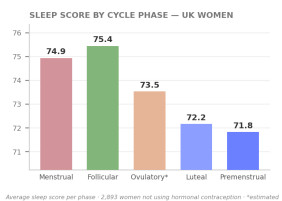
Paris, France, 15 October 2026: New research conducted by Withings analysed 469,000 menstrual cycles from 69,000 women globally including more than 5,000 women in the UK, finds that sleep quality falls in the week before a period for 3 in 4 women (76%). Average sleep score drops 3.4 points compared with the days just after a period, while night-time heart rate rises in 9 in 10 women, by 2.8 beats per minute on average. In the UK, sleep score falls by 3.5 points (to 71.8 in the week before the period), the fifth-largest drop of the 11 countries, and British women’s night-time heart rate climbs to 66.1 bpm, the third highest in the study, behind only the US and Australia.
A shared pattern, not a national one: In every one of the 11 countries, average sleep score fell by 2.9 to 4.0 points, and no country differed significantly from the rest. The dip is a consistent trend across all women, not a country-specific one; what differs is where women start.
Measured night after night: This analysis was made possible by data gathered by Withings smartwatches such as ScanWatch 2, smart scales such as Body Scan, BodyFit and BodyScan 2, and sleep trackers such as Sleep Analyzer.
Livia Robic Women’s Health Expert, Withings
“Looking across 469,000 cycles, the same pattern appears again and again: in the days before a period, night-time heart rate climbs and sleep becomes lighter, and the women whose heart rate rises most see the biggest drop in sleep quality. These are small shifts, but they are remarkably consistent from one country to the next. Knowing the pattern is normal and predictable can help women make sense of a restless night or a heavier morning on the scale, rather than worry about it.”
Staying Active Doesn’t Stop the Dip, and the Period-Week Weight Gain Is Fluid, Not Fat
British women are among the most active in the study, averaging 34 minutes of moderate-to-vigorous activity a day, second only to Finland, and their activity barely changes across the cycle (+34 steps a day in the premenstrual week). Yet their sleep falls just as much as everywhere else, suggesting the dip is not caused by women moving less. Body composition tells a similar story: during their period, 75% of UK women weighed more (+0.28 kg on average) while body fat stayed essentially flat (+0.04 points) and body water rose by 0.15 kg, meaning more than half of the gain on the scale is fluid, not fat.
Why Sleep Dips and Heart Rate Rises
After ovulation, the body produces progesterone, which raises core body temperature and shifts the nervous system towards a more alert state, pushing heart rate up and HRV down. A UK study of 6,812 exercising women recruited through the Strava app, led by researchers at St Mary’s University, Twickenham, found that 86% reported tiredness or fatigue linked to their menstrual cycle, and that cycle symptoms compromised their ability to exercise1. Because the body needs to cool down to enter deep sleep, a warmer body tends to sleep more lightly. The Withings data fits this picture: the dip began just after estimated ovulation and bottomed out 3–5 days before the period; it was larger in cycles with confirmed ovulation (−5.5 points); and women whose night-time heart rate rose most lost 7.0 sleep-score points, while those with the smallest rise saw no drop.
By Country: Key Sleep, Heart Rate and Body Composition Data (ranked by lowest sleep score)
|
Country
|
Women analysed
|
Sleep score, week before period
|
Sleep score change (pts)
|
Deep + REM sleep change (% pts)
|
Night-time heart rate, week before period (bpm)
|
Night-time heart rate change (bpm)
|
Weight change during period
|
Body fat change during period (% pts)
|
|
United States
|
8,643
|
68.5
|
−3.4
|
−1.0
|
68.6
|
+2.9
|
+0.29 kg
|
0.00
|
|
Australia
|
1,134
|
69.6
|
−3.5
|
−1.2
|
67.3
|
+2.9
|
+0.30 kg
|
+0.01
|
|
Norway
|
558
|
70.0
|
−3.5
|
−1.3
|
65.0
|
+2.9
|
+0.32 kg
|
+0.05
|
|
Sweden
|
672
|
71.3
|
−3.4
|
−1.1
|
64.7
|
+2.9
|
+0.27 kg
|
+0.03
|
|
Spain
|
738
|
71.5
|
−3.3
|
−1.1
|
64.7
|
+2.8
|
+0.22 kg
|
−0.05
|
|
Denmark †
|
338
|
71.5
|
−4.0
|
−1.6
|
64.7
|
+2.8
|
+0.25 kg
|
−0.16
|
|
United Kingdom
|
3,020
|
71.8
|
−3.5
|
−1.1
|
66.1
|
+2.8
|
+0.28 kg
|
+0.04
|
|
Italy
|
605
|
72.0
|
−3.4
|
−1.3
|
64.5
|
+2.7
|
+0.23 kg
|
−0.10
|
|
Germany
|
9,455
|
72.6
|
−3.5
|
−1.4
|
64.9
|
+2.8
|
+0.27 kg
|
+0.01
|
|
France
|
7,164
|
74.0
|
−3.4
|
−1.4
|
65.7
|
+2.8
|
+0.25 kg
|
−0.05
|
|
Finland †
|
385
|
74.1
|
−2.9
|
−1.6
|
64.8
|
+3.0
|
+0.25 kg
|
−0.06
|
|
All 11 countries
|
32,712
|
71.6
|
−3.4
|
−1.2
|
66.2
|
+2.8
|
+0.27 kg
|
−0.01
|
Countries ranked from lowest to highest premenstrual sleep score; red = least favourable value in each column. Changes vs the days just after the period (follicular phase), women not using hormonal contraception, age-standardised; levels are unadjusted averages. Sleep and heart rate: week before the period; weight and body fat: during the period. † Fewer than 500 women: interpret with caution. No country differed significantly from the rest on the sleep-score dip.
Women Using Hormonal Contraception See Less Impact on Sleep Quality and Heart Rate
The data also detected a much smaller impact among women using hormonal contraception. Across the 11 countries combined (3,362 women), their sleep score fell by 1.4 points in the week before their period, compared with 3.4 points in natural cycles, and their night-time heart rate rose by 1.0 bpm rather than 2.8 bpm. The drop in heart rate variability almost disappeared (−0.4 ms vs −3.0 ms). Because most hormonal methods smooth out the natural rise and fall of progesterone and oestrogen, this supports the role of cycle hormones in the pattern.
—
The Withings Menstrual Cycle Report 2026
Learn more about how sleep, heart rate, body composition and activity change across the menstrual cycle by reading The Withings Menstrual Cycle Report 2026: See here.
About Withings
A pioneer in real-life health monitoring, Withings created the first connected scale in 2009 and has continually innovated since then to offer an ecosystem of clinically validated connected objects, used by 12 million people worldwide, as well as by numerous renowned healthcare centers and research institutes. The Withings ecosystem measures over 90 biomarkers. It includes a sleep analyzer that detects sleep cycles, wake phases, and sleep apnoea. It also features hybrid connected watches that notably track heart rate and its variations day and night, perform a medical-grade electrocardiogram to detect pathologies like atrial fibrillation, or monitor blood oxygenation. Its connected blood pressure monitors allow for home monitoring of blood pressure evolution, thanks to sharing reliable and exhaustive measurement reports with a doctor, and can integrate a stethoscope for at-home recording of heart sounds that can be shared with a healthcare professional.
To learn more, visit withings.com.